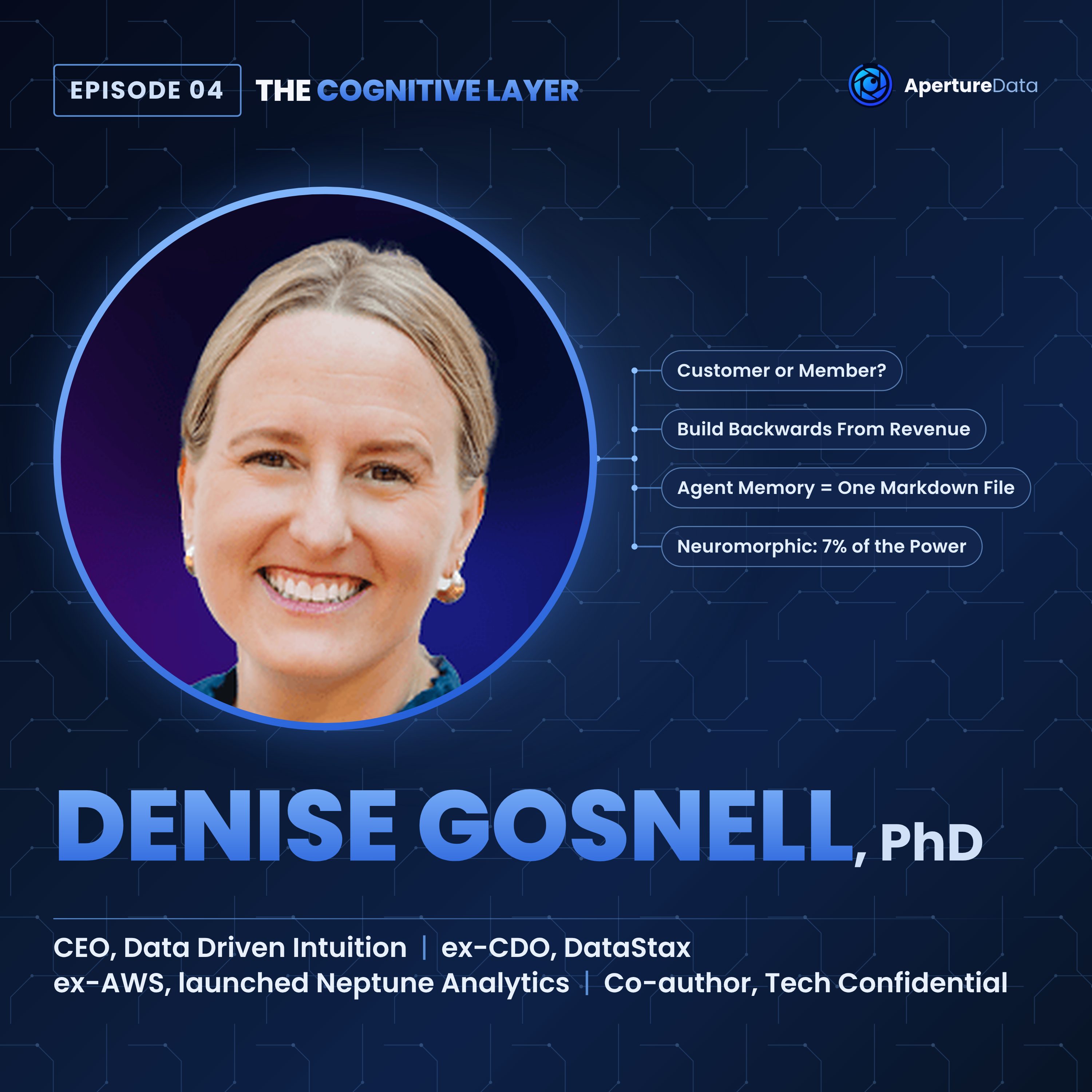


Notes from Episode 4 of The Cognitive Layer, with Denise Gosnell
Denise Gosnell is a co-author of Tech Confidential and The Practitioner's Guide to Graph Data (O'Reilly). She launched Amazon Neptune Analytics at AWS, was Chief Data Officer at DataStax, and holds a PhD in Computer Science from the University of Tennessee. Today she is CEO of Data Driven Intuition, which helps executive teams with AI strategy. Vishakha asked her about her ODSC talk, "Building Context that Pays."
Her main argument is plain. Every team in a company is racing to deploy AI, but the value comes when workflows connect across teams, and that still stalls on whether people agree on what a word means. The fix she sees working is not a new tool. It is a written document, agreed by humans, before anyone builds.
147 Pages of Docs: The Day a Database Launched Without APIs
Asked for the most cursed engineering fix she has had to defend, Denise said: "I had to defend launching an entire cloud-based database without any APIs." About 24 hours before a launch on a very large Las Vegas stage, her team found that its APIs clashed in name with the cloud provider's own APIs. They launched without exposing them. She spent the night going through 147 pages of documentation to hide certain APIs, and the APIs shipped about eight and a half days after launch. She has written about it in detail in Tech Confidential.
Customer or Member: Why Semantics Is Still the Main Blocker
Asked for the messiest data reality she sees in enterprises, her answer was the same problem as the launch: "Semantics, things on what they mean, and making sure it's consistent." A team building APIs for other teams has its own closed-world view of what a word means.
She described the pattern: "one team calls a customer this one thing, and then another team wants to call it a member." Each unit has "a fire lit under them to deploy faster," and that is good for individual team productivity. The real value, she said, comes from connecting workflows across silos, and that depends on
"human readable and accurate shared language on what is what and how to translate it from one entity to another."
Her summary: "It's still the main blocker, and that's still moving at the pace of human instead of the pace of AI."
We've written before about why decisions need shared, structured context in Context Graphs And Their Implementation.
Writing Is Thinking: A Document Detailed Enough for Four or Five Departments
Vishakha asked how large organizations get everyone to one meaning. Denise said she is testing ways, and what she sees working starts with a belief: "I wholeheartedly believe that writing is thinking." The practice is to lead with a written document that describes the end product, detailed enough that about four or five separate departments can take it and run with it in their own context.
That synthesis has to happen across marketing, go to market, customer success, product and engineering. It is a hard moment to plan for, she said, but it is how she sees teams get through the problem and scale.
Science Experiment or Revenue: Tie the Architecture to a Goal
Asked what separates an AI architecture that earns revenue from an expensive science experiment, Denise gave an engineer's test. First, look for a clear tie to a high executive goal. Even that is not enough, "because executives can still make bets," so look for a revenue-generating goal.
Her example is a multi-billion-dollar private company she is working with, which she described as a technology laggard. They asked where to start. In their industry, clients want personalized travel recommendations, so that became the North Star, and the team worked backwards: a recommendations API, performant to a stated SLA, and the databases needed to hit it.
"You build specifically for hitting that API because you know it's going to generate revenue."
She also uses the revenue tie with engineers. Showing them the pipelines sit inside an executive-sponsored, revenue-generating goal gives them "a little bit more safety in their role" and "more autonomy over their code." She added that this takes empathy so the work does not feel purely transactional.
The Compiler Is Not AI: SQL as the Shared Definition
The process behind that example is the Amazon working-backwards approach and its key document, the PRFAQ. Denise said you can have agents write the PRFAQ, "but the whole point is that there's a moment where humans pause" and read what you believe you are building. In her PRFAQ she goes as far as the SQL: which source data is used and how it is computed.
She explained how that connects to DataSQRL, where she is an advisor. A data engineer, a business owner and an engineer look at the SQL and ask whether it is accurate for the business. Then DataSQRL compiles that SQL into the end-to-end architecture, from ingest to pipelines to the GraphQL API that serves the metric. "That part is not AI, it's actually a compiler," she said, and it is open source.
SQL or Natural Language: Where Vishakha Pushed Back
Vishakha said she is in the minority camp that has a problem with everything being SQL, coming from a multimodal angle. When building ApertureDB, the team needed graph search combined with vector search and access to images, videos and documents. A JSON-based query language made it easier to extend to new data types, and the overhead mattered less when working with large objects. She asked what the interface would look like if SQL were not the default.
Denise said she identifies with that, and that "we are in the world of letting natural language be that layer," in Hungarian, French, Mandarin, English or any other. For the enterprise recommendation system, SQL was "a common language that everyone could speak that was also technically precise enough." On whether to use English or a short statement like db.customer.id equals db.member.other_id, she said: "I feel like we're splitting hairs." Her position: "I'm finding SQL to be precise enough. I see the world where natural language is becoming the new standard."
Donna: Agents That Take Your Time Back for Human Interaction
Denise named her personal executive-assistant agent Donna, after the character in Suits. She built it for fun, to bring a smile back to her day, with a joke in the occasional email, "the light, warm-heartedness I was bringing into it from an empathy perspective."
She does not object to enterprise agents being cold and efficient, because she sees AI as a way to take your time back "to bring more humanity into your day." A conversation like this one is something only people can do. "AI is a duality, right? There's good and bad with every choice." Agents can organize information and save time, but they can also automate away interactions with other people. She tries to err "on the side of more human interaction."
An Agent Is a Markdown File: The Simplest Memory That Works
Asked how she manages Donna's memory and context, Denise offered "the most boring answer": "we know an agent's just a markdown file." Each week Donna reviews the status of her projects, communications and what has moved, and updates her own skill file, which is versioned in GitHub.
She came from building database engines at AWS for the Fortune 100, "taking memory to the absolute max," and wanted to experience the other end from the ground up. So she chose the simplest solution, the one she believes most people start with, to see where it falls down. For now: "a version control markdown file on my agent's instructions. That's it. That's all I need." Vishakha said they should reconnect in a couple of months to see whether she needed to move beyond it.
We have been working on agent memory in the open with Aperture Nexus, our open source memory layer built on ApertureDB.
7% of the Power: Why She Is Watching Neuromorphic Computing
Denise also collaborates on neuromorphic computing. She did her PhD at the University of Tennessee and pointed to Dr. Schuman's lab there, which has built up a neuromorphic computing center. On a tour of the lab she saw a full neuromorphic hardware stack solving the pole balancing problem in simulation, a common test for a new machine learning model.
"The neuromorphic hardware stack was able to solve it in 7% of the power. 7%."
The idea, as she described it, is to model chips more like a brain, with electricity going from one node to many. She thinks the efficiency "could really change the physical footprint of our future," and called it slow but "very promising."
Asked what it means for data storage and retrieval, she was candid: "other than it's a complete rewrite of the whole stack, I don't know how it's gonna change." What she does know is that holding a massively sparse graph over billions of nodes in memory is hard today. "That fine line between data size, sparsity, and compressing it in memory. That's the game that we're all trying to figure out right now." Vishakha said she would invite Denise back to talk about the neuromorphic stack as it develops.
Words That Mean Things: Agree Before You Build
Asked for the practical tools that make her productive, Denise went back to the document process. It matters even more for leaders adding an AI agent to their organization as a new workflow, because that requires shared context, "and shared context by humans has got to be written down." She ruled out PowerPoint slides and images for this: "You need words that mean things and you need to communicate it and get everyone to agree."
Her last word on it:
"Reaching that point of agreement before you build is going to be one of the best accelerators you can give yourself."
Connect With Denise: LinkedIn, Her Books and Her Writing
Denise Gosnell on LinkedIn: https://www.linkedin.com/in/denisekgosnell/ Her website: https://denisegosnell.ai/ Tech Confidential by Denise Koessler Gosnell and Kathryn Erickson (Simon & Schuster): https://www.simonandschuster.com/authors/Denise-Koessler-Gosnell/261630142 The Practitioner's Guide to Graph Data (O'Reilly): https://www.oreilly.com/library/view/the-practitioners-guide/9781492044062/
This is the fourth episode of The Cognitive Layer. Full conversation available on Spotify and YouTube.